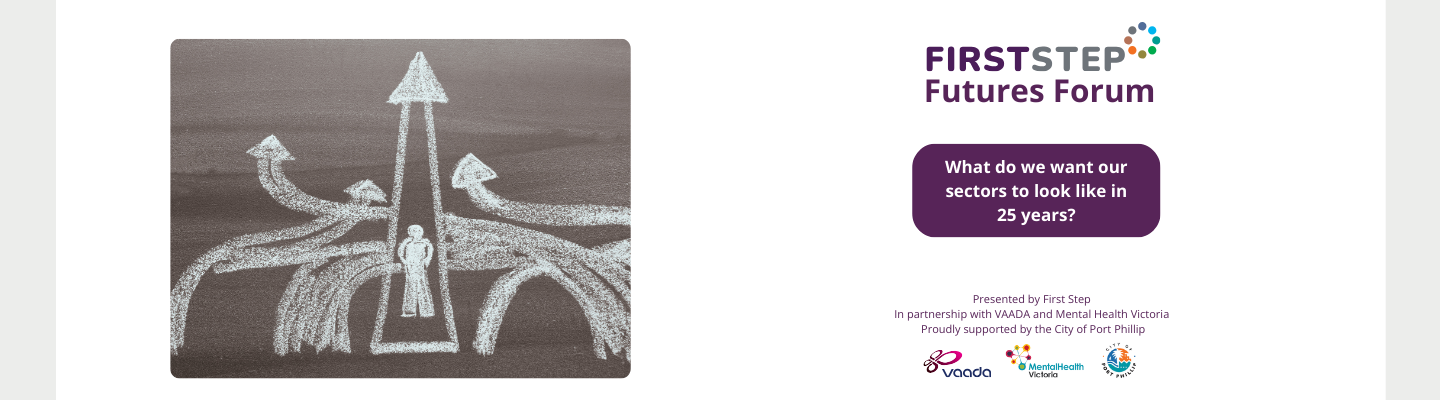
On February 11, at St Kilda Town Hall, three leaders working in distinct but closely related sectors will take to the stage to discuss what they and their colleagues will need over the next 25 years to enable the best possible outcomes for the people they seek to support.
MCed by anti-gambling advocate and former Mayor of St Kilda, Rev Tim Costello, the forum will feature Clare Davies, CEO Self-Help Addiction Resource Centre, Sheree Lowe, Social and Emotional Wellbeing VACCHO, and Prof Pat McGorry, Executive Director Orygen. Together, they will lift their eyes to the horizon and think big.
Across mental health, substance use, and Aboriginal health and wellbeing, they will combine their lived experience, their heartfelt commitments, and their imaginations to paint a picture of what could be. I can’t wait.
In the meantime, I want to reflect on what I think these sectors have in common, and how that commonality, and shared learning, can be harnessed to think across sectors, and to envisage what our systems might need in order to better support people with co-occurring needs.
So, where is the common ground? In all three sectors, we can plot a spectrum of life experience from thriving to struggling. Mental health is a spectrum, or several spectra, encompassing everything from flourishing through to the most acute and dangerous risks. ‘Substance use’ is a term deliberately developed to include the full gamut of alcohol and other drug experiences, from a glass of wine with dinner to life-threatening, chronic polydrug use. Aboriginality itself is a source of strength, culture, and pride, and has no ‘flip side’. What we do know, however, is the profound injustice of Aboriginal people experiencing lower life expectancy and other outcomes that reflect some of the worst health inequity in the world.
While we rightly strive to see the people we support through a strengths-based and resilient lens, another thing that binds our sectors together is that people come to us when they need help. Whether they are an Aboriginal person, a person seeking support for substance use, a person living with mental distress, or any combination of these, they are navigating one or more challenges. Coming to our services is itself a brave act, and one that carries the possibility of positive change.
What else do our sectors share? A statistician searching for commonality or causality would almost certainly point to poverty. Poverty is the “cause of the causes” of mental illness, as Michael Marmot puts it. It represents not only the present-day reality for many people in our sectors, but also the historical conditions that caused or compounded their difficulties. Adverse Childhood Experiences occur far more frequently among children living in poverty, and the poorer the child, the worse the statistical averages. In the context of mental illness and substance use, poverty can be understood as the metaphorically infertile soil in which thriving becomes far less likely. Poverty is both causal and compounding, of mental illness and of substance use, which themselves can then become causal and compounding in turn. Poverty is also arguably the single greatest factor underpinning the stubborn failure to close the gap for Aboriginal people. Solve poverty, and much else would follow.
So, we need to reverse the current trend and reduce wealth disparity. Raising the JobSeeker allowance to the level of the aged pension would be a good start. So too would phasing out negative gearing, so that an average young person working full time can realistically aspire to owning a home, a change that would also reduce rents, which is arguably more important.
Then there is stigma. Stigma permeates all our sectors, including its most virulent forms, racism and discrimination. The liberal agenda of human rights and equality of opportunity is being challenged globally, and here in Australia, by the rising popularity of the far right. There is no neat fix here, no equivalent of a ‘destigmatising allowance’. What is imperative, however, is that we never assume the world is naturally bending toward greater compassion.
Martin Luther King Jr famously said, “The arc of history is long, but it bends towards justice.” I desperately hope that is true, but I’m pretty sure it doesn’t happen without the effort of millions of people. There is no inertia in this direction, only the constant struggle for equality by those who experience its absence, and by those with the influence or resources to support that struggle.
I’ll finish with integration. In health and science, the 20th century is often described as the century of specialisation. Extraordinary advances were made across medicine, and specialisations emerged in every conceivable field. But in doing so, our bandwidth to see the whole person has undoubtedly diminished, and we now need to reclaim it. This is particularly true in the context of chronic conditions, including mental illness and substance use, not least because one chronic condition so often leads to another, and another again.
Seeing the whole person, what they need, where they need it, and crucially, why they need it, is the starting point. Building an entire health ecosystem around the assumption that those with the greatest needs will have co-occurring needs is work for the rest of the 21st century.
When we fail to see the whole person, or when we invest in health in ways that are disproportionate to need, we fail to achieve a return on our investment of time and money. Instead, we end up funding hospitals and prisons, institutions that cost billions and are sites of immense human suffering. We need to think ahead and fund proportionate to need, for example burden of disease, if we are serious about removing discrimination from our health systems.
Societies always pay their debts. The only real choice is whether we pay early, strategically, compassionately, and relatively cheaply, or late, punitively, and at enormous human and financial cost.
I’m looking forward to February 11 and to hearing what our speakers call for. Will there be strong common ground? Will new ideas predominate, or will we hear the familiar drums being beaten once more? Let’s see.
