I wrote some months ago on the topic of negative gearing of investment properties (and the paired capital gains tax concessions), never suspecting that the federal government was soon to make a change in this area. This, to me, was a welcome surprise that centres the conversation around right to housing, not right to wealth.
Please insert all the caveats about people lawfully utilising tax law to create wealth and caveats about nice landlords; I’m sure there are thousands. It just shouldn’t be easier for an investor to finance a property than an owner/occupier. If anything, wouldn’t we try to tip things towards the owner/occupier?
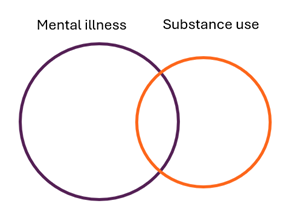
So, why is someone from a mental health, drug and alcohol and legal services centre writing about this? Because poverty is the "cause of the causes" of mental illness (British epidemiologist Sir Michael Marmot). And why is that? Because it paves the way for childhood trauma (Melbourne not-for-profit worker Patrick Lawrence). The Venn diagram of mental illness and substance use is two almost entirely overlapping circles.
People think it’s this:
But really, it’s this:
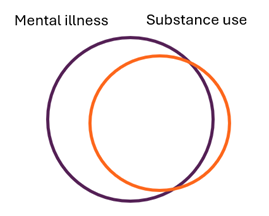
And that should be no surprise, because:
a. These conditions are causal (triggering) and compounding (worsening), and
b. They often share the same roots: trauma, adversity, poverty and social exclusion.
The worst aspect of unaffordable housing is not high mortgages, but high rents, because people living in poverty and suffering its stresses never have a mortgage, they have a landlord. Financially, we could all rent for our whole lives (it’s standard in most of Europe) as long as the rents were low enough that we could still live a good and healthy life and generate wealth and security in other ways.
So, housing policy is mental health (and addiction) policy, because poverty is mental health policy.
The legislation will remove much of the market distortion and taken a bit of pressure off. We cross our fingers that this will at least slow the trend of increasing unaffordability of rents and mortgages, and thereby reduce the stress of poverty, gradually.
It has taken the left side of politics decades to finally legislate this change; remember Bill Shorten losing the unlosable election? It reminds me of a ‘joke’.
Q. When is the best time to plant a tree?
A. 20 years ago.
Q. When is the second-best time?
A. Now.
The same might be said of tackling the social drivers of poverty, trauma, mental illness and substance use.
| Patrick Lawrence Chief Executive Officer |
 |
